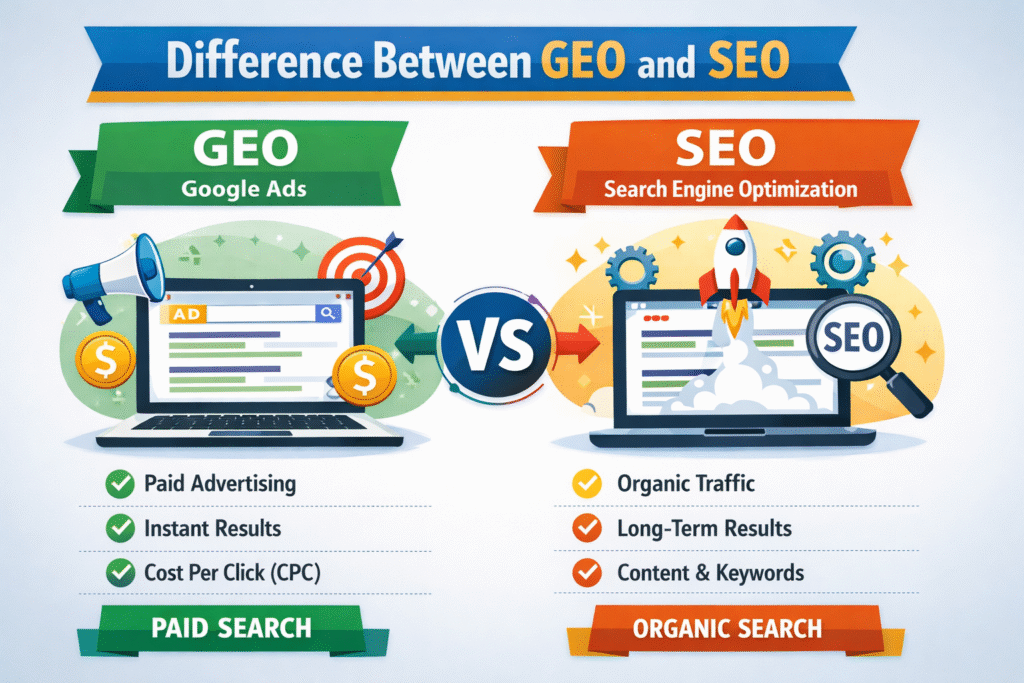
Difference between GEO and SEO
What is the Difference between Generative Engine Optimization (GEO) and Search Engine Optimization (SEO) ? The internet marketing scene is evolving at a very fast rate. Over the years, the only method companies use is Search Engine optimization (SEO) in an effort to increase their presence on the internet and reach out to organic traffic. However, with the development of AI-powered generative engines such as ChatGPT, Google Gemini, Perplexity AI, etc., another concept was coined, which is Generative Engine Optimization (GEO). Although the goal of SEO and GEO are similar in terms of visibility, they work in a very dissimilar way. The purpose of SEO is to promote web pages in search engines, and the purpose of GEO is to make its content understandable and persuasive regarding the artificial responses provided by AI. The enumeration of the key differences between GEO and SEO in terms of numbers and bullet points is discussed below in 800 words and in a systematic manner. 1.What is meant by Search Engine Optimization (SEO)? Search Engine Optimization (SEO) refers to the process of ranking websites in a manner that they appear high in the search engine result pages (SERP) whenever the user key-word in question, which is the pertinent one, is being searched. Key Features of SEO: Advertisements are placed on the traditional search engines like Google and Bing. Focuses on optimization of key words. Application of backlink in order to increase authority. Foundations on technical factors such as velocity and mobility. Main Objective of SEO: To rank top on the search results list. To increase organic traffic To make clicks, leads, and conversions. 2. What is Generative Engine Optimization (GEO)? The concept of Generative Engine Optimization (GEO) may be defined as the craft of organizing the content of any type to allow the AI-based sites to understand, select, and repurpose the content in the process of generating direct answers to the queries supplied by users.As opposed to search engines, generative engines do not show a list of links. Instead, they provide summarized and conversational responses based on a number of reliable sources. Key Features of GEO: Attacks generative platforms using AI. Is preoccupied with fact and factuality. Employs a natural and conversational language. Makes the content authoritative and quotable. Main Objective of GEO: To be a trustworthy source of knowledge to the AI. In order to be seen in AI generated responses. To build a long term power and trust. 3.Critical Dissimilarity between GEO and SEO In SEO, the content is optimized so that it ranks and receives clicks. GEO simplifies the process of understanding the content and using it again in the AI. In simple terms: SEO is traffic-focused GEO is knowledge-focused 4. Target Platforms SEO Platforms: Google Bing Yahoo DuckDuckGo GEO Platforms: ChatGPT Google Gemini Perplexity AI Claude AI-based digital assistants GEO Platforms: Key difference: SEO targets search engines GEO is concerned with artificial intelligence reasoning systems. 5. Content Discovery Process How SEO Works: User types a keyword or query Search engines index the pages. Pages are ranked by using algorithms. User clicks a result How GEO Works: User asks a question AI analyses a number of data sources Artificial intelligence is a summary answer One can cite or refer to content Key difference: SEO depends on clicks GEO is dependent on knowledge and re-use. 6. Keyword Usage: SEO vs GEO SEO Keyword Strategy: Primary keyword Secondary keywords Long-tail keywords Keyword density Exact-match phrases GEO Keyword Strategy: Natural language Conversational phrasing Question-based content Semantic relevance Comprehensive information, as opposed to repetition. Key difference: SEO optimizes for keywords GEO means optimization of meaning and intent. 7. Differences in Content Structure SEO Content Structure: H1, H2, H3 headings Meta description and meta titles. Internal linking Skimmable paragraphs GEO Content Structure: Clear explanations Lists of numbers and lists of bullet points. Comparisons and definitions. Logical and factual flow Key difference: SEO is designed for crawlers GEO is directed to an interpretation of AI. 8. Authority and Backlinks SEO Authority Signals: Outbound links of reputable sites. Domain authority Anchor text relevance GEO Authority Signals: Credible and valid data. Periodic expertise on the matter. Quotes and mentions of brand names. Key difference: SEO values links Credibility and trust are valued by GEO. 9.Measurement and Analytics SEO Metrics: Organic traffic Keyword rankings Click-through rate (CTR) Conversions GEO Metrics: AI citations or mentions The presence in the responses produced by AI. Content reuse by AI tools Authority recognition Key difference: SEO success is quantitative The success of GEO is a qualitative and up-and-coming one. 10. Business Impact SEO Benefits: Increased website traffic Lead generation Sales growth Brand visibility GEO Benefits: Thought leadership AI-driven visibility Brand trust Digital presence, next generation 11.Final Conclusion Out of the contrast between Generative Engine Optimization (GEO) and Search Engine Optimization (SEO) is the process in which content is found and read. SEO focuses on the positions and clicks whereas GEO focuses on the consideration that it is a credible source of information in answer to the inquiries concerning AI-generated answers. Businesses are in need of a hybrid solution because the AI continues to alter how users are searching information. SEO will be used to attract the attention of users to websites and GEO will ensure that it is visible in the AI platforms. SEO and GEO can be considered as a future of digital marketing as a whole.